Somewhere along the way, outlining got a reputation. Say the word to a discovery writer and they picture a forty-beat spreadsheet, every scene pinned down before a single sentence exists — the story dissected before it was ever alive. If that's outlining, no wonder half of us refuse.
But that's not outlining. That's one outlining method, built by and for a particular kind of writer. The plotter/pantser binary flatters both camps into thinking there are only two ways to work, when in practice almost nobody lives at either pole. Every "pure" pantser is holding something in their head — an ending, a vibe, a scene they're writing toward. Every "pure" plotter abandons the plan the moment a character does something better than what was scheduled.
The real question isn't whether to outline. It's how much structure helps you, and when. Here are four methods that answer that question differently — all of them compatible with discovering the story as you go.
1. The headlights outline
E.L. Doctorow said writing a novel is like driving at night: “You can see only as far as your headlights, but you can make the whole trip that way.” The headlights outline takes him literally. You never outline the book. You outline the next two or three scenes — the stretch of road your lights actually reach — and nothing beyond.
Before each writing session, jot a line for what happens next: Mara finds the letter. She confronts her brother. It goes worse than she expects. That's the whole outline. When you've written those scenes, the ending of what you just wrote tells you what the next two or three are — because now you know things about the story you couldn't have known before.
This preserves everything discovery writers love (the story still reveals itself) while killing the blank-page problem (you always sit down knowing what today's scene is). The failure mode of pure pantsing isn't bad plot — it's stalling, mid-book, with no idea what happens next. Headlights outlining makes that moment structurally impossible.
2. The wake outline
Here's the method almost nobody talks about: outline behind yourself. Write the scene first, discovering whatever you discover. Then — after — write its one-line synopsis, as if you were outlining a book that happens to already exist.
It sounds like paperwork. It's actually one of the highest-leverage habits in drafting, for two reasons. First, summarizing a scene in one line forces you to know what it does — and scenes that resist summary are usually scenes that aren't doing anything, which is worth learning in one sentence rather than three chapters later. Second, by the time you finish the draft, you own a complete map of the book you actually wrote — which is exactly the document revision needs, and the one plotters' outlines never become, because the draft always drifts from the plan.
The wake outline is never wrong, never constrains you, and is always up to date. It's pure record, zero prescription.
3. Landmarks, not routes
Between the headlights and the full itinerary, there's a middle scale: know three to five fixed points, and nothing about the roads between them. An opening image. A midpoint reversal you can already feel. The ending — or even just the ending's temperature. Maybe one scene you've been carrying around since before the book had a title.
Landmarks give you what discovery writers actually need from structure, which is not a schedule but a bearing. When you're lost in the middle — and you will be lost in the middle, that's what middles are — you don't need to know the next turn. You need to know which direction the mountain is. Everything between landmarks stays improvised, and if the draft produces a better mountain, you move the landmark. It was always yours.
4. The question outline
Instead of writing what happens in a chapter, write what the chapter asks. Not “Torrey collects the debt and takes the daughter instead of gold” but “What is Torrey willing to accept in place of what he came for?”
An event outline is a cage: the scene must produce that event. A question outline is a compass: the scene must engage that question, but every answer is legal — including answers that surprise you. You keep the shape of an outline (a list of chapters, each with a purpose) while writing each scene as a discovery writer. Many writers who “can't outline” discover they can outline questions indefinitely; it's answers-in-advance they were allergic to.
Making it stick
Whichever method fits, two mechanical details decide whether it survives contact with the draft.
Keep the outline next to the manuscript, not in another app. An outline you have to go find is an outline you'll stop consulting around chapter six. This is much of why we built Charc's outline and manuscript as two views of the same scenes — a synopsis you write in one is already in the other, and updating the outline after a scene (the wake method) is ten seconds in the sidebar rather than a context switch.
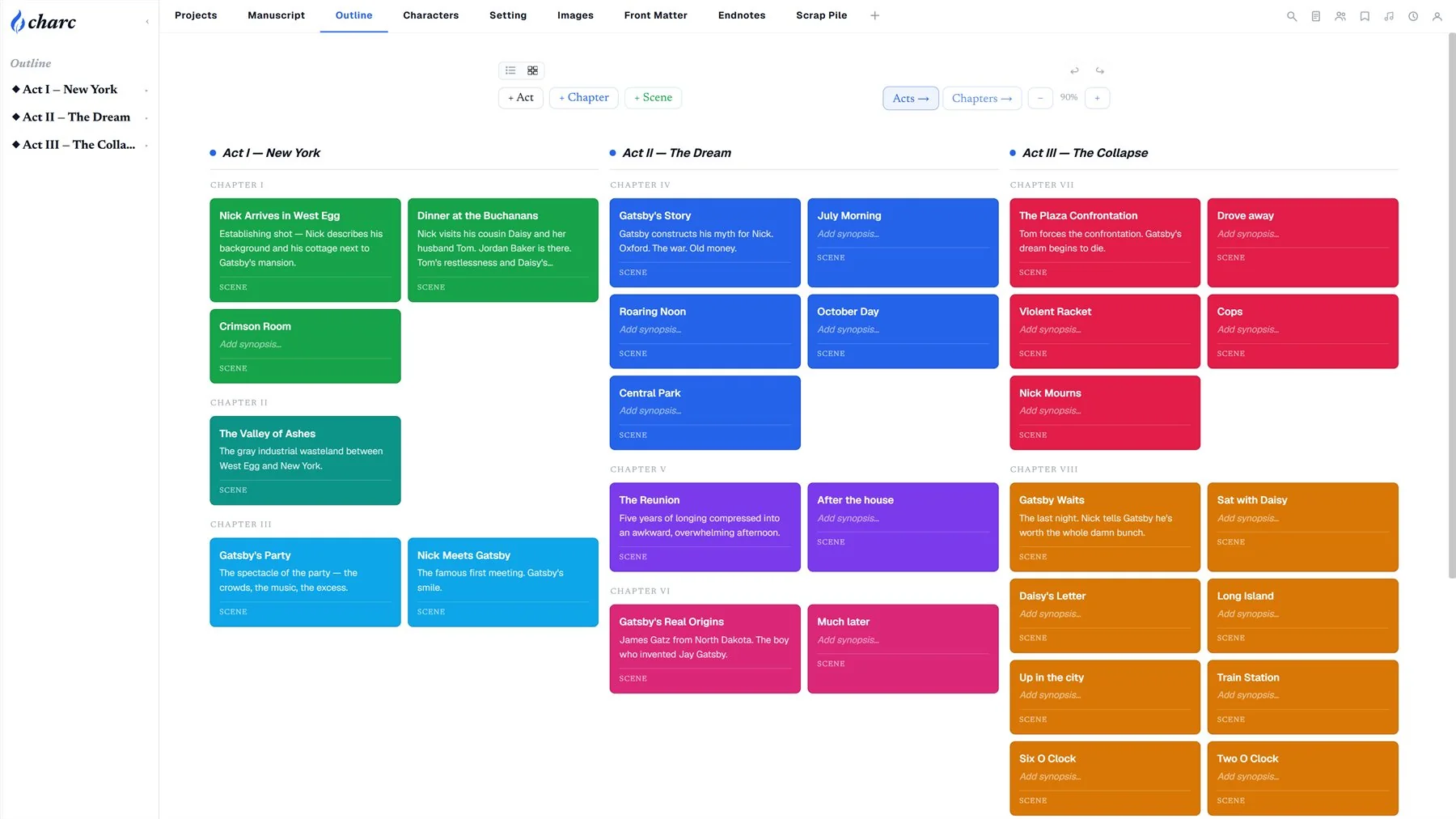
Make the outline visual when you need shape, textual when you need detail. Landmarks and question outlines benefit enormously from a zoomed-out view — scene cards on a board, acts side by side — where the book's proportions are visible at a glance: a bloated act two looks bloated; a thin act three looks thin. Detail work (synopses, POV notes) belongs in the list. Use both; they're the same data wearing different clothes.
You are not a plotter or a pantser. You're a writer with a book that needs different amounts of light at different moments — headlights in the dark stretches, landmarks when you're lost, questions when answers would spoil it, and a wake of clean synopses trailing behind you for the day you turn around and revise.